
The Project Portfolio of Sebastian Wallach
Trail Planning at Rock Solid Trail Contracting
In 2023, after completing my degree in Mechanical Engineering and Environmental Studies at Lafayette College, I joined Rock Solid as a Trail Planner. In this role, I oversee projects from the first conversation with a client through design and into the construction kickoff. My work includes client engagement, mapping, budgeting, estimating, and on-the-ground field design. These responsibilities have taken me across the United States, its territories, and even into Europe, giving me the chance to bring diverse landscapes and communities into the trail planning process.
Below, I'll highlight some of the projects that I am most proud of so far in my career.
Horseshoe Canyon Ranch
Jasper, Arkansas
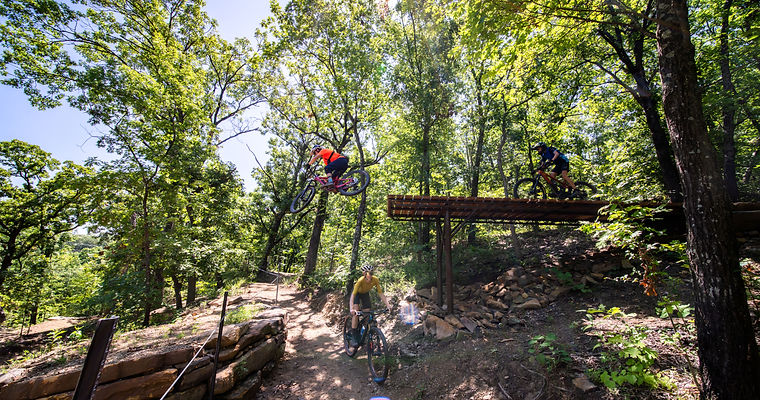
Starting in 2023, I worked under Aaron Rogers and alongside Jon Schubbe to design a trail system that blended seamlessly into the already thriving climbing and outdoor recreation community at Horseshoe Canyon Ranch (HCR). Confronted with house-sized boulders, steep gradients, and a wandering herd of goats, we began surveying the property to understand its possibilities. With over 700 feet of vertical drop from the canyon rim to the valley floor, we knew an enduro and downhill zone would be essential, but we also aimed to capture the sweeping high-canyon vistas with cross-country trails that connected the entire property.
Over the next two years, this vision took shape as an artistic masterpiece of dirt and rock, built largely by hand by our incredible construction teams. Flagging trail at HCR was both exhilarating and demanding—its wealth of natural features made every alignment an opportunity, while the loose ground and constant elevation change kept us on our toes.
The final system delivered more than 15 miles of trail, including a skills area rich with natural features, beginner trails capped in gravel, technical yet rewarding XC routes, and some of the fastest, gnarliest, and most flowy downhill lines we could imagine.
Looking back, the HCR project profoundly shaped me as a trail designer. I learned more than I could have imagined in that canyon, and I’ll always think of it as a second home here in the Natural State.

.jpg)
.jpg)

Turkey Mountain
Tulsa, Oklahoma
From 2024 - 2025, I worked alongside Sammi Runnels to design and refine The Sanctuary—a distinctive new trail zone within the Turkey Mountain Urban Wilderness in Tulsa, Oklahoma. The vision was to create a network that rewarded precision, patience, and bike handling skills, using the mountain’s sandstone outcrops, narrow ridgelines, and twisting forest corridors as the foundation for the riding experience.
Unlike high-speed flow trails with large fabricated features found at the N. Enduro Zone, The Sanctuary is built for deliberate riding. Every line encourages riders to slow down, read the terrain, and choose the most efficient path through natural rock features, off-camber turns, and squeezes between trees. Countless hours were spent flagging routes that highlighted these features while ensuring sustainable construction that would hold up under Turkey Mountain’s heavy year-round use.
The final product is a series of trails that encourages all riders to explore and blends seamlessly into the surrounding landscape. Selective rock armoring preserved the character of the terrain, while hand-finished sections create an intimate, natural feel. The result is a space where riders can test their balance, line choice, and focus while fully immersed in the mountain’s beauty.
Working on The Sanctuary deepened my appreciation for the subtleties of trail design, teaching me how to maximize challenge and engagement without relying on massive vertical changes or huge parcels of land. What we developed here is something for everyone!



Flint State Park Design
Flint, Michigan
From 2024 – 2025, I worked on the design of the Flint State Park Trails Project, an ambitious effort to weave trail-based recreation into the fabric of downtown Flint. The vision was to link four of the city’s key outdoor spaces—Happy Hollow, Mott Park, Chevy Commons, and the Riverwalk—into a single, connected system that blends natural landscapes, urban corridors, and community access.
Unlike standalone parks or isolated trail zones, this project was designed as a continuous experience. Spanning over 10 miles, the system creates a true through-route across the city, offering not only recreation but also opportunities for commuter cycling and off-street connectivity. Riders and walkers can now move seamlessly between neighborhoods and natural resource areas, experiencing Flint’s landscape in a new, cohesive way.
Each area contributes its own character: Happy Hollow’s wooded ravines provide a sense of escape, Mott Park serves as a community anchor, Chevy Commons offers wide open green space and a hub of activity, and the Riverwalk ties it all together along the water’s edge. Within this framework, we also integrated skills-building zones in Happy Hollow and Chevy Commons—featuring custom-fabricated features for balance, cornering, and technical riding—that provide progression for beginners and challenges for seasoned riders.
Designing this system in an urban setting required balancing sustainability with accessibility. Trail alignments were chosen to manage heavy use and variable soils, crossings and armoring protected sensitive zones, and every access point was planned to feel intuitive, safe, and welcoming from surrounding streets.
The finished product is more than a collection of trails—it’s a multi-layered network that connects neighborhoods, supports active transportation, and invites people to play, commute, or simply explore. Working on the Flint State Park Trails Project deepened my appreciation for how trails can serve as both recreation and infrastructure, tying communities together while celebrating the landscapes they move through. Soon, construction will commence on several parts of the design, and these ideas and flaglines will come to life!


Searcy Master Trails Plan
Searcy, Arkansas
Rock Solid Trail Contracting was invited to evaluate the City of Searcy, Arkansas, for its potential to expand and enhance trail infrastructure. Over the course of several days, the Rock Solid team collaborated with project stakeholders and local experts to explore Searcy’s diverse green spaces and identify areas where trail development could create meaningful community impact.
During this on-the-ground assessment, Rock Solid identified significant opportunities to transform underutilized green spaces into vibrant community assets through linear trails, skill zones, and session areas. These enhancements would activate currently overlooked areas and support recreation, transportation, and community well-being.
The evaluation also considered the city’s existing and planned active transportation infrastructure, upcoming public amenity construction, and existing trails in need of improvement. By integrating Rock Solid’s soft-surface trail designs with Searcy’s broader transportation vision, the city can achieve a highly connected, user-friendly trail network.
The following pages outline Rock Solid’s recommendations for trail corridors throughout the city, including conceptual cost estimates and mapping. Each section includes representative imagery to illustrate the envisioned trail types, features, and intended users for each area.


Legacy Park Phases Two & Three
Northville, MI
Project Overview
Legacy Park is a newly established green space in Northville, Michigan, envisioned as a multi-use outdoor recreation destination for the local community. In 2024, I led design work for Phases 2 and 3 of the park’s master trails plan, focusing on expanding trail offerings and creating a cohesive user experience as the park continues to open to the public.
Design Process
My work began in winter, with extensive field assessments and corridor flagging completed alongside teammate Ethan Edman. We spent a week onsite analyzing terrain, identifying sensitive areas, and marking the alignments that would ultimately guide the 2025 construction season.
Throughout the design phase, I collaborated closely with Northville Parks & Recreation and key local stakeholders to refine trail concepts and ensure that the system reflected community needs. Because Legacy Park is a high-demand space with a limited footprint, much of the planning involved balancing multiple recreational priorities while preserving the site’s natural character.
Key Challenges
-
Space Constraints: As a brand-new green space, Legacy Park faced competing demands for trails, community features, and resource protection. Strategic layout and careful prioritization were critical to maximizing what could be accommodated.
-
Navigation & User Flow: With diverse trail types, several inholdings, and existing infrastructure to work around, creating intuitive navigation was a central focus.
-
Diverse Trail Experience: Designing for a wide range of users—from casual walkers to dedicated mountain bikers—required thoughtful transitions and clear trail identity.
Design Solutions
-
A Network of Trail Hubs: We incorporated multiple hubs and directional routes to simplify navigation and allow users to customize their outings without confusion.
-
Intentional Trail Diversity: The final network includes a balance of multi-use trails, singletrack, and varied difficulty levels to meet the needs of the broader community.
-
Field-Driven Alignment: Every trail corridor was flagged based on on-the-ground observations, ensuring sustainable grades, engaging terrain, and minimal ecological impact.
Outcome
The Rock Solid build teams completed construction in late 2024, and it has been rewarding to see the Northville community embracing the new trails as winter approaches. The system is intuitive, diverse, and tailored to a park that is quickly becoming a cornerstone of outdoor recreation for the region.
I look forward to returning to Northville next year to ride the trails myself and continue supporting Legacy Park as it grows.


Prairie Rock Trails Bike Park
Mason City, IA
Project Overview
Prairie Rock Trails Bike Park is a purpose-built mountain bike facility designed to bring progressive, modern riding opportunities to Mason City, Iowa. The project was envisioned as a community-driven destination that would serve riders of all ages and abilities while establishing a strong trail identity in a region with limited elevation and natural terrain.
I supported the design effort for Prairie Rock Trails Bike Park, contributing to layout development, feature placement, construction budget development, and progression planning to ensure the park delivered engaging riding experiences while remaining approachable and sustainable.
Design Intent
The primary goal of Prairie Rock Trails was to create a bike park that balanced accessibility with progression. The design emphasizes skill development, rider flow, and repeatability. This allows users to build confidence while gradually advancing to more technical and higher-consequence features. Given the site’s prairie landscape and subtle topography, careful shaping and efficient use of elevation, along with mass grading efforts, were central to the design process. Trails and features were intentionally aligned to maximize momentum, minimize unnecessary pedaling, and create a cohesive riding experience across the park.
Key Challenges
-
Limited Natural Relief: Designing compelling bike park trails in low-relief terrain required creative grading, efficient use of fill, and precise feature sequencing.
-
Progression for All Skill Levels: Ensuring beginners felt welcome while still providing advanced riders with meaningful challenges was a core design consideration.
-
Community Accessibility: As a public bike park, Prairie Rock needed clear sightlines, intuitive navigation, and predictable trail difficulty to support a wide range of users.
Design Solutions
-
Intentional Progression Zones: Trails and features were organized to clearly communicate difficulty and allow riders to progress naturally from beginner-friendly lines to more advanced options.
-
Flow-Focused Layout: Berms, rollers, jumps, and rhythm sections were designed to work together, emphasizing speed control through terrain rather than braking.
-
Efficient Use of Space: Compact trail loops and shared climb access maximized ride density while maintaining safety and visibility throughout the park.
-
Modern Bike Park Standards: Feature geometry, sightlines, and trail separation were designed to align with contemporary best practices for bike park construction and rider safety.
Outcome
Prairie Rock Trails Bike Park has become a cornerstone of Mason City’s outdoor recreation offerings, providing a dedicated space for skill development, community events, and everyday riding. The park demonstrates how thoughtful design can transform modest terrain into a high-quality riding experience and serves as a model for bike park development in similar landscapes.Contributing to Prairie Rock reinforced the value of intentional progression, clear user communication, and creative problem-solving when working within tight site constraints.


